
Europe’s “AI Cake” Is Taking Shape: Compute, Power and Sovereignty in the Age of AI Factories
Europe’s AI strategy is entering a new phase. While public attention often focuses on models and applications, policymakers are increasingly concentrating on the foundations that make AI possible: computing capacity, energy systems, data infrastructure and access to advanced HPC resources. The result is a growing recognition that Europe’s competitiveness will depend also on the strength of the lower layers of the AI stack.
From AI applications to AI infrastructure
Artificial intelligence is often viewed through its visible outputs: conversational assistants, content-generation tools and increasingly capable foundation models. However, a growing body of analysis suggests that the real transformation is taking place beneath the surface.
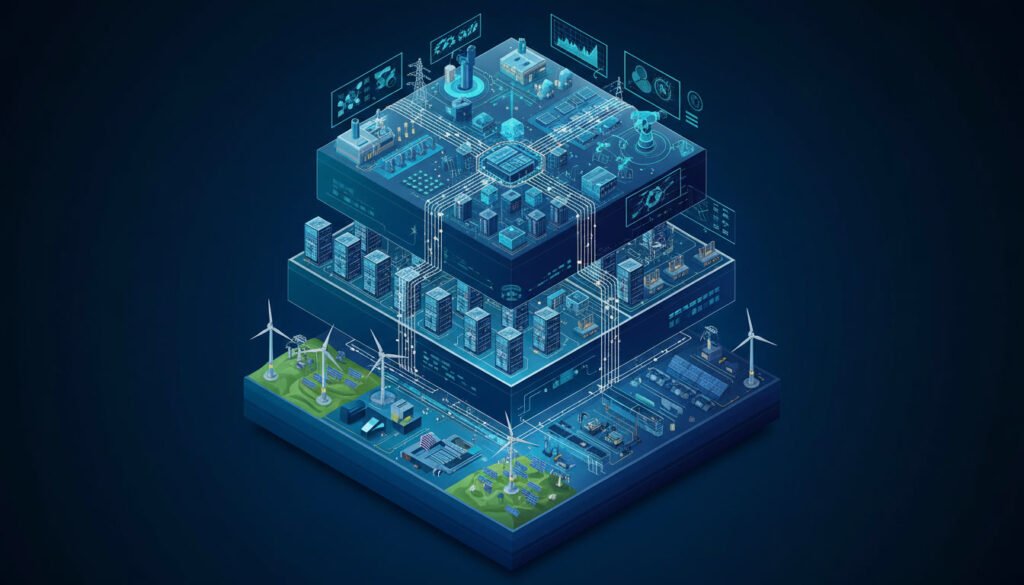
At World Economic Forum 2026 discussions, the concept of a multi-layer AI ecosystem gained renewed prominence, highlighting how AI capabilities ultimately rest upon infrastructure layers that include energy, computing systems, networks, platforms and applications. AI is increasingly being described as one of the largest infrastructure build-outs in modern history, requiring sustained investment in physical and digital assets as well as software innovation [1].
This perspective aligns closely with current European policy. Through the AI Continent Action Plan, the European Union is placing infrastructure at the centre of its AI agenda, recognising that access to large-scale computing resources has become a strategic capability for research, innovation and industrial competitiveness [2].
Building sovereign capacity
The debate around European AI sovereignty is evolving. Earlier discussions focused primarily on regulation and governance, but attention is increasingly shifting towards operational capabilities: compute, data, networks and energy.
Recent discussions across Europe have highlighted a key reality: technological ecosystems are globally interconnected, yet regions still need secure access to critical capabilities. For AI, that means ensuring that researchers, startups, industry and public institutions can access advanced computing infrastructure within Europe [3].
The European response is increasingly visible through the expansion of the EuroHPC Joint Undertaking ecosystem and the deployment of AI Factories across participating countries. These facilities aim to provide rapid and scalable access to advanced computing resources for AI development, helping reduce dependency on external compute providers while fostering European innovation capacity [2,4].
Data centres move to the centre of industrial policy
As AI workloads grow, so does the importance of the facilities that host them.
Across Europe, new infrastructure projects are being designed specifically to support large-scale AI workloads. One prominent example is the proposed sovereign AI campus in Bordeaux, planned around 250 MW of IT capacity with access to 380 MW of available power, illustrating the scale at which future AI systems are expected to operate [5].
More broadly, digital infrastructure is increasingly being viewed as a component of industrial policy, linking innovation goals with energy planning, regional development and technological resilience. Data centres are no longer simply support facilities; they are becoming strategic assets that underpin research, economic growth and digital sovereignty [5].
The energy question
Perhaps the most significant challenge lies beyond computing hardware.
The rapid expansion of AI is creating growing pressure on electricity systems across Europe. According to the AI and the energy sector briefing published by the European Parliamentary Research Service, data centres currently account for approximately 3% of total EU electricity demand, while global data-centre electricity consumption is expected to more than double by 2030. AI-focused facilities place particularly high demands on both power supply and cooling infrastructure, increasing pressure on local electricity networks [2].
At the same time, Europe is pursuing ambitious plans to expand its AI capacity. The AI Continent Action Plan identifies large-scale AI data and computing infrastructure, including AI Factories, as a cornerstone of Europe’s competitiveness strategy. The planned Cloud and AI Development Act is expected to support a substantial expansion of European data-centre processing capacity over the coming years [2].
These ambitions must be reconciled with a challenging geopolitical and energy landscape. Europe continues to face exposure to global energy-market volatility linked to geopolitical tensions and dependence on imported fossil fuels. While renewable deployment is accelerating, the global energy system remains significantly reliant on fossil fuels, leaving electricity prices vulnerable to supply disruptions and geopolitical shocks. Ensuring abundant, affordable and sustainable electricity is therefore becoming a strategic prerequisite for Europe’s AI ambitions [2].
Concerns about energy affordability are becoming increasingly prominent in discussions about European AI competitiveness. In a recent Reuters Open Interest commentary, it was argued that Europe’s ability to compete in AI will depend not only on computing infrastructure but also on access to affordable electricity through a more integrated and efficient European energy market. While representing the author’s analysis rather than official EU policy, the commentary reflects a broader concern that fragmentation in energy markets could become a constraint on Europe’s AI ambitions, particularly as demand from AI and data-centre infrastructure continues to grow [6].
The challenge is not limited to electricity generation. The European Parliamentary Research Service notes that grid infrastructure is emerging as a critical bottleneck, with transmission-line projects often requiring 4-8 years and grid-connection queues ranging from three to ten years in advanced economies. As AI infrastructures grow larger and more compute intensive, future competitiveness will depend not only on processors and algorithms, but also on grid modernisation, renewable deployment, energy storage and smarter energy management [2].
These trends reinforce a simple conclusion: there can be no AI infrastructure without energy infrastructure. Europe’s ability to scale AI will depend as much on the resilience of its energy system as on the performance of its computing platforms [2].
What it means for Europe
Taken together, these developments suggest that Europe’s AI strategy is moving down the stack.
The next phase of AI competition may not be decided solely by who develops the most capable model, but by who can provide sustainable access to compute, data, energy and infrastructure at scale. Europe’s investments in AI Factories, Gigafactories and advanced HPC resources reflect a growing understanding that infrastructure has become a strategic asset in its own right [1], [2], [4].
For the HPC and AI communities, this shift creates both an opportunity and a responsibility. Europe already possesses world-class scientific expertise and a strong HPC tradition. The challenge now is to translate these strengths into the infrastructure foundations required for the next generation of AI innovation. In this context, the MINERVA European Support Centre supports researchers, startups, industry and public-sector users in navigating Europe’s rapidly evolving AI and HPC ecosystem.
References
[1] Davos 2026: Jensen Huang On The Five Layer AI Cake, The AI Bubble And Key AI Breakthroughs, Forbes, Jan. 2026.
[2] AI and the Energy Sector, European Parliamentary Research Service (EPRS), PE 775.859, July 2025. Available at: https://www.europarl.europa.eu/RegData/etudes/BRIE/2025/775859/EPRS_BRI(2025)775859_EN.pdf
[3] Europe should be ‘realistic’ about tech sovereignty, says top chips exec, POLITICO Europe, Jan. 2026.
[4] InvestAI Initiative and AI Gigafactories, European Commission, 2025-2026.
[5] 250MW Data Center Planned for Bordeaux, France, to Boost National AI Capabilities, Data Center Dynamics, Jan. 2026.
[6] Europe has no hope in AI race without a unified energy market, Martin Vladimirov, Reuters Open Interest, 16 Sept. 2026.
No responses yet