
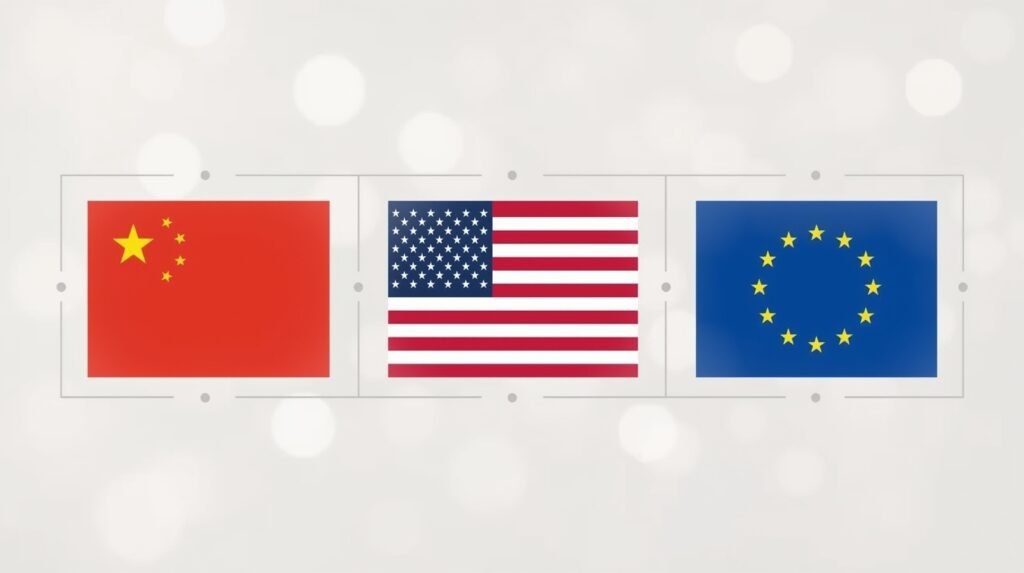
The Geopolitical Race for AI Leadership: Decoding Strategies of the EU, USA, and China
The global landscape of Artificial Intelligence (AI) is undergoing a rapid, transformative shift, and nations are keenly aware that technological supremacy translates directly into economic, military, and geopolitical power. The recent publication of comprehensive AI strategy documents from the European Union (EU), the United States (USA), and China underscores the critical nature of this competition. For technical experts and policymakers, understanding these blueprints is vital, as they not only dictate investment priorities and research direction but also set the fundamental ethical and operational boundaries for future AI systems worldwide.
The race is defined by the potential for AI to usher in simultaneous revolutions across industry, information, and intellectual achievement. Whoever establishes the largest and most robust AI ecosystem will set the global standards and reap enormous benefits. Therefore, these strategic documents—the EU’s AI Continent Action Plan and Apply AI Strategy, America’s AI Action Plan, and China’s AI Plus Initiative—are essentially roadmaps for achieving global technological dominance or self-sufficiency, making their comparative analysis a necessity for navigating the future of technology.
Key Differences Shaping the Global AI Landscape
While all three powers recognize AI as a critical strategic asset, their motivations, governance philosophies, and implementation methodologies reveal fundamental differences.
1. Governance and Regulatory Philosophy
The most profound divergence lies in the approach to regulation. The EU is anchoring its entire strategy on developing “trustworthy and human-centric AI”. This is codified in the AI Act, which provides a single, clear set of safety rules across the EU Single Market to ensure AI aligns with fundamental rights and values. The EU prioritizes preventing market fragmentation and enhancing trust in AI usage.
In stark contrast, the USA explicitly mandates removing “red tape and onerous regulation”. The American strategy emphasizes private-sector-led innovation, arguing that restricting AI development through bureaucracy would paralyze one of the most promising technologies seen in generations. Furthermore, the U.S. plan focuses on ensuring AI systems are objective and free from perceived ideological bias, instructing agencies to eliminate references to concepts like Diversity, Equity, and Inclusion (DEI) and climate change from federal AI risk frameworks.
China’s approach is accelerationist and open source oriented, viewing the lack of development as the biggest security risk. While China acknowledges the need to guard against risks and improve AI laws and ethical standards, its strategy is primarily concerned with mass diffusion across society. China frames open source as more than a technical choice; it’s a cultural and economic paradigm. Articles from the Chinese Academy of Sciences link open source to Confucian ideals of harmony and collective benefit, positioning it as a cultural and economic paradigm for global influence.
2. Strategic Goal and Economic Engine
The USA’s explicit goal is “unquestioned and unchallenged global technological dominance”. The strategy is highly focused on national security, with the American plan mentioning security no fewer than 24 times. China’s objective is rooted in economic transformation, utilizing AI to power New Quality Productive Forces (NQPFs) and maintain growth amidst demographic contraction. The AI Plus Initiative seeks widespread integration (targeting 70% penetration in key sectors by 2027), leveraging AI as a core engine for restructuring production factors and reshaping value chains. This contrasts with the EU’s aspiration to become a “leading AI continent” by capitalizing on its single market, research excellence, and human-centric values.
3. State Direction and Resource Mobilization
The Chinese approach involves strong state direction and immense resource mobilization for self-sufficiency. The government acts as a key buyer, facilitator, and strategic director, aiming to build an autonomous and controllable hardware and software ecosystem.
The USA favors market-driven solutions and private-sector leadership in innovation. The government’s role is primarily to dismantle regulatory barriers and facilitate access to computing power for startups and academia through mechanisms like the NAIRR pilot.
The EU relies on a collaborative public-private model, launching the InvestAI initiative to mobilize EUR 200 billion for investment in AI infrastructure, emphasizing shared, publicly accessible infrastructure like EuroHPC supercomputers and planned Gigafactories.
The Distinct Strengths of the EU Strategy for Citizens and Business
The EU’s distinctive strategy, built around trust and competence, offers significant advantages for its citizens and businesses, setting it apart from the purely competitive or purely diffusionist models of its rivals.
Benefits for Citizens
The European strategy places fundamental rights and principles at its core. The AI Act ensures that AI systems deployed in areas like healthcare, justice, and public administration are safe and ethical. For instance, AI in healthcare aims to bring transformative benefits to wellbeing, such as enabling earlier and more accurate diagnoses and improving efficiency in underserved areas. The Commission plans to establish AI-powered advanced screening centers to accelerate the introduction of innovative prevention and diagnosis tools, explicitly integrating gender-specific factors. Furthermore, to ensure public trust and understanding, the EU is investing heavily in AI literacy and skills through initiatives like the AI Skills Academy, promoting a human-centric digital transition. The AI Act Service Desk is being established as a central information hub to provide straightforward, free access to guidance on the regulatory framework, particularly benefiting smaller innovators.
Benefits for Business
For European businesses, especially SMEs and start-ups, the EU strategy offers powerful structural advantages. The existence of a large single market with one set of clear rules (the AI Act) prevents fragmentation, drastically simplifying cross-border operations and making European AI systems globally attractive as a “selling point”.
Infrastructure investment is focused on scaling up public and private capacities. AI Factories and eventually AI Gigafactories—large-scale facilities integrating massive computing power—are designed to give researchers, innovators, and industry (including startups and SMEs) the necessary resources to train and finetune frontier models. The initiative to deploy 13 AI Factories across 17 Member States, reaching EUR 10 billion in investment, is a cornerstone of this effort. Additionally, the upcoming Apply AI Strategy directly targets the limited AI adoption rate (only 13.5% of EU companies in 2024), refocusing European Digital Innovation Hubs (EDIHs) to become Experience Centres for AI to support SMEs and mid-caps in adopting sector-specific solutions. The open innovation model, championed by EuroHPC, encourages knowledge sharing and transparency, which benefits collaboration and integration across the economy.
MINERVA’s Role in Supporting EU AI Strategies
The MINERVA project (European Support Centre for Scalable AI Research and Deployment) is designed to directly address the core infrastructural and skills challenges outlined in the EU’s AI strategy documents, positioning Europe as a leader in applying High-Performance Computing (HPC) to AI.
MINERVA focuses on advancing HPC-AI knowledge and bridging the existing gap in HPC utilization by AI communities. By acting as a central hub for large-scale Machine Learning (ML)/AI R&D competencies, MINERVA supports the EU’s imperative to accelerate AI adoption and build robust infrastructure.
- HPC Infrastructure Uptake: The EU is investing heavily in EuroHPC systems, AI Factories, and Gigafactories. MINERVA ensures these investments are maximally utilized by providing support services for porting AI applications and workflows onto HPC infrastructures (Level 1 support). This assistance ensures that AI users, including commercial entities and researchers, can effectively scale up their workloads on systems like Leonardo and MareNostrum 5.
- Fostering Open Source and Innovation: A special emphasis in MINERVA is placed on the research and development of open-source foundation models. The project provides advanced support (Level 3) for the pre-training and specialization of these large-scale open models. This directly strengthens the European brand of open innovation and technological sovereignty by ensuring the reuse of high-quality models and datasets within the European digital ecosystem.
- Strengthening Skills and Talent: The EU relies on initiatives like the AI Skills Academy. MINERVA complements this by initiating a comprehensive training program (WP5) aimed at bridging the HPC knowledge gap prevalent in the AI community. This includes “Train-the-Trainers” courses aimed at local initiatives like NCCs and EDIHs. Furthermore, the project establishes a Community Hub to connect ML/AI researchers and engineers, ensuring a constant flow of expertise and state-of-the-art knowledge, which is crucial for capacity building and research excellence.
- Ensuring Trust and Compliance: MINERVA provides Expert Support on regulations on ethical and responsible AI. This service helps users concretely address compliance challenges stemming from the AI Act (e.g., issues related to ethical and responsible AI, such as data selection to avoid unfair behavior). By doing so, MINERVA provides practical mechanisms that reinforce the EU’s core commitment to developing trustworthy and ethical AI systems.
In conclusion, MINERVA functions as a vital conduit, translating the EU’s high-level strategic ambitions regarding infrastructure, research, and governance (AI Act) into actionable, technical support services and capacity-building programs across the continent.
References
- EU AI Continent Action Plan (and Annexes): COM(2025) 165 final, Brussels, 9.4.2025
- EU Apply AI Strategy (and Annexes): COM(2025) 723 final, Brussels, 8.10.2025
- USA America’s AI Action Plan: JULY 2025, The White House
- China’s AI Plus Initiative: Issued by the State Council on August 26/28
No responses yet